- Issued
- December 8, 2025
- Drawn by
- Hanna Kang, P.E., CCM
- Reading
- 11 min
- Discipline
- Construction Management
What Does an Owner's Representative Do?
Building a new plant means working with brokers, designers, agencies, and contractors. An owner's representative is the one person who works only for you, from finding the site to starting production.
Why do contractors pay attention when an owner's rep walks in?
You may run a production line in Korea or manage a plant in the U.S. You know your equipment, your process, and your people. Then your company decides to build or convert a facility, and suddenly you are surrounded by brokers, architects, engineers, city officials, and contractors.
Everyone in that room knows construction better than you do. They know what is normal, what is negotiable, and where the extra costs usually hide. That knowledge gap is where owners lose money.
An owner's representative closes that gap. When the owner has someone at the table who speaks the same technical language and works only for the owner, the conversation changes. Proposals get read line by line. Extra-cost requests get questioned. Deadlines get tracked. That is why experienced contractors take notice.
What is an owner's representative?
An owner's representative, often called an "owner's rep," is a construction professional the owner hires to manage a building project on the owner's behalf. The owner's rep guides the project through planning, design, permits, and construction, with one job: to protect the owner's money, time, and goals.
A simple way to picture it is this. Your company already has people who represent you in other areas. A lawyer represents you in legal matters. An accountant looks after your financial records. An owner's rep does the same thing for your construction project.
Three things define the role:
- We work only for the owner. We are not paid by the contractor, the architect, or the seller. Our advice is never tied to who gets the work or how much they earn from it.
- We are your eyes and ears. We attend the meetings, walk the site, read the documents, and report back to you regularly in plain language, so you always know where the project stands.
- We connect everyone. A project has many separate teams. We make sure your plan reaches each of them clearly and that their work fits together.
You can hire an owner's rep for the whole project, from site search to move-in. Or you can hire one for a single phase where you need help most, such as checking a building before you buy it or reviewing contractor bids before you sign.
Your project, from start to finish
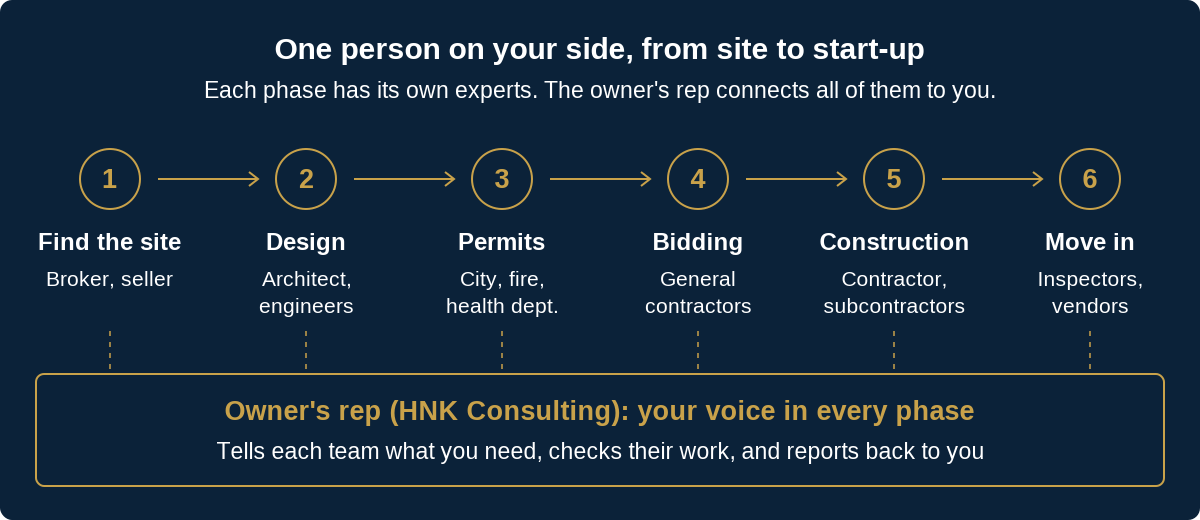
The circles are the phases. Under each are the experts you hire for it. The owner's rep runs underneath all of them, from the first site visit to the start of production.
Each phase has its own experts. We connect them all to you.
In every phase, you hire specialists. They are good at their part. Our job is to tell each of them what you need, check that they deliver it, and keep the whole project moving toward one goal: your plant, running on time and on budget.
| Phase | Who you work with | What we do for you |
|---|---|---|
| 1. Find the site | Real estate broker, seller | The broker helps you buy or lease. We check if the building can actually run your process: power, ceiling height, floor strength, drains, zoning, and permit history. |
| 2. Design | Architect and engineers (A/E firm) | We turn your production plan into clear instructions for the designers: your lines, equipment, and workflow. Then we check the drawings against your budget. |
| 3. Permits | City, fire, and health departments, utility companies | We know what each agency needs and in what order. We keep the paperwork moving so the project does not sit in a queue. |
| 4. Bidding | General contractors who bid on the job | We make sure every bid prices the same work. We find what is missing before you sign. |
| 5. Construction | General contractor and subcontractors | We are your eyes and ears on site. We check payment requests, extra-cost claims, schedule, and quality, and report back to you and your headquarters. |
| 6. Move in | Inspectors, equipment vendors | We close out inspections, get your occupancy approval, and collect warranties and final drawings, so you can start production. |
Two common mistakes owners make
Someone always ends up playing the owner's rep role on a project. The question is whether that person has the right experience. Most owners who skip a professional owner's rep make one of two mistakes.
Mistake 1: "Our own team can handle it."
Many companies give the project to their plant manager, facilities manager, or an engineer from headquarters. These are capable people. But managing a U.S. construction project is a specialized skill that usually takes years of hands-on experience to learn.
An internal team often does not know which questions to ask. They may not recognize a missing item in a bid, a weak clause in a contract, or a permit requirement that will add months. They also still have their regular jobs, so the project gets attention only when something goes wrong.
Mistake 2: "The contractor will take care of us."
This is the most common assumption, especially for companies used to working with large design-build firms in Korea. Most contractors are honest and professional. But a contractor is a business with its own goals. It is paid to build what is in its contract, at the best margin it can.
When the drawings are unclear, the contractor has every reason to read them in the way that costs you more. When a schedule slips, it has every reason to explain why it was not its fault. That is not bad behavior. It is simply how the business works. The owner needs someone who looks at the same facts from the owner's side.
The same is true for other consultants. A broker earns a commission when a deal closes. A designer may earn more when the project scope grows. Their advice can be good, but it is never fully independent. An owner's rep has no stake in any of those outcomes.
Every team protects its own interest. Who protects yours?
Here is the plain truth that few people tell owners directly:
The contractor, the architect, and the engineers will always act in their own best interest first. If the owner does not know enough to question them, the owner pays the difference.
This is not about bad people. It is about how the business works. Each company signed its own contract, carries its own risk, and needs to make a profit. When something is unclear, each one will naturally choose the answer that is safest and most profitable for itself, not for you.
Here is what that looks like on real projects:
| Situation | Without an owner's rep | With an owner's rep |
|---|---|---|
| The drawings leave out a detail | The contractor prices it later as a change order, and the owner pays extra | We catch the gap during design review and get it fixed before bidding |
| A bid is much lower than the others | The owner picks it, and the missing work returns as extra charges | We find what was excluded and compare all bids on the same scope |
| The contractor asks for more money | The owner pays, because it is hard to argue without knowing the contract | We check whether the work was already included, and push back when it was |
| The design grows bigger than needed | The owner pays for more building and more design fee than the operation requires | We keep the design tied to your actual production needs and budget |
| The design team does not mention cost or schedule impacts | The owner finds out at bidding, when it is expensive to change | We ask about cost and schedule at every design decision |
| The schedule slips | Each party explains why it was someone else's fault, and the owner absorbs the delay | We track the cause, hold the responsible party to it, and push a recovery plan |
| A dispute comes up | The owner has no one on site who can argue the technical facts | We document the facts and handle it early, before it becomes a claim |
The pattern is the same every time. The other teams know the rules of construction well, and the owner usually does not. The owner's representative stands between them and you, knows the same rules, and makes sure every decision is made in your interest.
Who's who: owner's rep vs. contractor vs. construction manager
A fair question at this point: "Doesn't the general contractor or construction manager already do some of this?" Yes, some of it. The real difference is not the tasks. It is whose side each person is on.
| Role | Main job | Whose interest comes first |
|---|---|---|
| Real estate broker | Finds a property and closes the deal | The deal closing (paid by commission) |
| Architect and engineers | Design the building and prepare drawings for permits | Their design scope and professional standards |
| General contractor | Builds the project under its contract | Its own contract, cost, and profit |
| Construction manager (CM) | Manages construction work; depending on the contract, may be part of the builder's team | Defined by its contract |
| Owner's representative | Manages the whole project from start to finish | The owner, and only the owner |
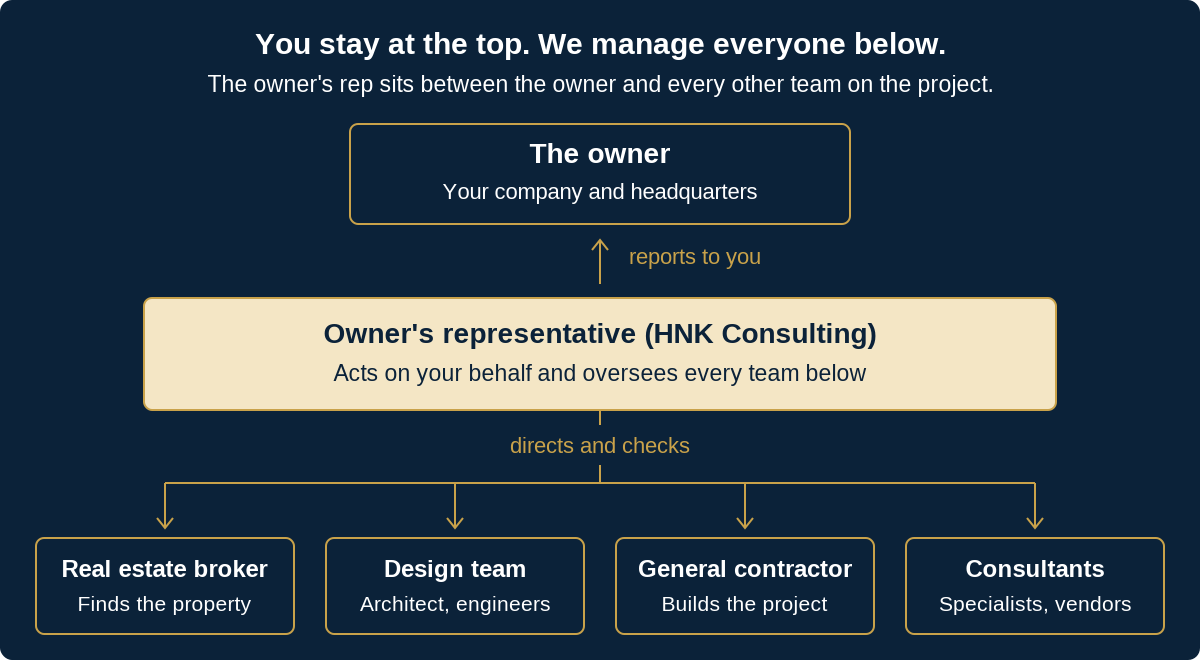
The owner's rep sits at the top of this picture. While each team focuses on its own part, we look at the whole project: does every piece still add up to the facility you need, on the date you need it, for the budget you approved? We hold the big picture on your behalf, so that you do not have to manage every team yourself.
How we protect your budget
Your financial goals stay at the center of every decision we make. Our aim is simple: that every dollar you spend on the project buys something you actually need.
Here is what that looks like in practice:
- Before you sign, we compare bids line by line. Two bids can look close in price but cover very different work. We make sure every bidder is pricing the same scope, and we point out what each one left out.
- We help negotiate the contract. We look at payment terms, allowances, exclusions, and how changes will be priced. These details decide how much the project really costs, long after the contract is signed.
- We review every payment request. Contractors are usually paid monthly, based on how much work they say is done. We check that the work is actually in place before you pay for it.
- We watch for "scope creep." This is when small changes and additions slowly pile up. Each one looks minor. Together, they can add a large amount to the final cost.
- We check every extra-cost request. When a contractor asks for more money, we check whether that work was already part of the contract. If it was, you should not pay twice.
- We look for smart savings. The industry calls this "value engineering": finding a less expensive material or method that still meets your needs. The key is knowing what can be changed safely and what cannot.
- We know when a price is too high, and when it is too low. A bid that seems too good to be true often is. A very low price can mean missing work, which comes back later as extra charges.
A simple example
Imagine you receive three bids to convert a warehouse into a food plant. One bid is much lower than the other two. It looks like an easy choice.
When we read the details, we find that the low bid excludes the upgraded fire sprinklers, the floor drains your process needs, and the electrical service upgrade for your equipment. Those items are not optional. They would come back later as change orders, at prices you can no longer negotiate, and often with delays. Once those items are added back, the "cheap" bid may be the most expensive of the three.
This kind of finding takes a few hours of careful review before signing. Finding it after signing can cost far more.
How we protect your schedule
In construction, time and money are tied together. You cannot manage one without managing the other.
For a manufacturer, a late building is not just a late building. Think about what a few months of delay really means:
- You keep paying rent or loan interest on a building you cannot use yet.
- Staff you already hired are waiting with nothing to run.
- Equipment arrives from overseas and has nowhere to go, or sits in storage.
- Customer orders and product launches move back, and so does your revenue.
- The contractor's own costs keep running too, and some of those may come back to you.
So when we manage the schedule, we are really protecting your budget. Here is how:
- We build one master schedule that covers everyone: designers, agencies, the contractor, and your equipment vendors. Most delays happen in the gaps between teams, not inside one team's work.
- We track key milestones every week and compare actual progress to the plan, so small slips are caught while they are still small.
- We hold each party accountable. When a deadline is missed, we find out why, what it affects, and what the recovery plan is.
- We plan around permits. Agency reviews are often the longest and least predictable part of a project. We prepare complete submittals, respond to comments quickly, and follow up so your project does not sit in a queue.
- We coordinate your equipment. We make sure the building is ready for your production equipment when it arrives, with the right power, utilities, and floor space in place.
How we reduce risk
Most expensive construction problems do not start big. They start as something small that nobody noticed in time:
- A building that looked perfect, until the team learned its electrical service could not support the new equipment.
- A drawing that left out a detail, so two trades each assumed the other would handle it.
- One unclear sentence in the contract that turned into a long argument over who pays.
- A health or fire department requirement that nobody mentioned until the final inspection.
Experience is what catches these early. After years of managing projects, you learn where problems usually hide and what the warning signs look like. We look for them on purpose, at every phase.
When disagreements come up, and on most projects some will, we work to settle them early, with facts and documents, before they grow into formal claims or disputes. A disagreement solved in a site meeting costs far less than one solved by lawyers.
There is one more part of risk that is easy to miss: honesty. Because we work only for you, we have no reason to hide bad news. If something is going wrong, you hear it from us right away, while there is still time to fix it, and not months later in an explanation.
For a manager whose expertise is production, not construction, this is the real value: peace of mind that someone experienced is watching every part of the project on your behalf.
Why it matters even more for Korean companies
Many of our clients are Korean companies building or converting their first facility in the U.S. They are strong, experienced manufacturers. But the way construction works in the U.S. is different, and the differences show up in predictable places.
- The owner carries more responsibility. In Korea, a large construction company often handles much of the coordination for the owner. In the U.S., the owner is usually expected to manage the designers and the contractor directly, and to make many decisions along the way.
- There are many separate approvals. A food or manufacturing plant may need sign-off from the city building department, the fire department, the county health department, air quality regulators, and utility companies. Each agency has its own rules and timeline.
- Contracts work differently. Words like "excluded," "allowance," and "by owner" can quietly move large costs back to the owner. U.S. contracts also rely heavily on written documentation: what is not written down is hard to claim later.
- Headquarters is far away. Key decisions are often made in Korea, in Korean, in a different time zone. Someone has to explain the project to headquarters clearly, and carry headquarters' decisions back to the U.S. team accurately.
This last point is where many projects struggle. It is not only about language. It is about translating technical and business meaning in both directions: why a permit is taking longer, why a change order is or is not fair, what a decision will cost. We work in both Korean and English, so headquarters and the local team always see the same picture.
Stuck in the middle of a project? That is when to call us.
Every owner reaches a point in the project where they simply do not know what comes next. It happens to experienced managers too. Construction has its own order of steps, its own paperwork, and its own vocabulary, and most of it is not written down anywhere an owner would look.
These are the kinds of questions owners bring to us:
- "We just signed the lease. What do we do first?"
- "Do we hire the architect first, or the contractor?"
- "The city sent back our permit with comments. What do they want, and who should answer?"
- "The contractor says this work is extra. Is that true?"
- "Our equipment arrives in three months. Will the building be ready?"
- "Headquarters is asking why the project is late. How do I explain it?"
- "The inspector failed us. Now what?"
Without someone to ask, owners usually do one of two things. They wait, and the project stops while they search for answers. Or they ask the contractor or designer, and get an answer shaped by that company's own interest.
An owner's rep is the person you can call with any of these questions, at any stage. We tell you what the step means, what your options are, what each option will cost in time and money, and what we recommend. Then we help you carry it out. You never have to guess, and the project keeps moving.
Is it worth the cost?
An owner's rep fee is usually a small share of the total project budget. The exact amount depends on the size of the project, how complex it is, and how much help you need. You can hire us for the full project, or for one phase only, such as a building check before you buy or a bid review before you sign.
The better way to think about the fee is to compare it with what it protects. Ask yourself what any one of these would cost your company:
- One large change order for work that should have been in the original contract
- One permit requirement discovered late, after the walls are closed
- One month of delayed production, with rent, staff, and customer orders waiting
- One building purchase that turns out to need major upgrades before it can be used
Avoiding even one of these can be worth more than the cost of an owner's rep. Construction is complex, and owners who try to handle it alone often learn that lesson the expensive way. So the real question is not whether you can afford an owner's rep. It is whether you can afford to go without one.
Does your project need an owner's rep?
The earlier you bring one in, the more value you get. The decisions that affect cost the most are made before construction starts: which building to buy, what to design, and what the contract says. By the time the first change order arrives, most of those choices are already locked in.
If you answer "yes" to two or more of these questions, it is worth a conversation:
- Are you buying or leasing a building and planning to change how it is used, for example from a warehouse to a food plant?
- Is this your company's first construction project in the U.S., or the first in many years?
- Is there no one on your team who has managed a U.S. construction project from start to finish?
- Do you have proposals on your desk and are not sure they cover the same work?
- Is your headquarters overseas, and do they need one trusted local contact who reports clearly?
- Is your project already underway, and are costs or the schedule starting to drift?
Even if the project has already started, it is not too late. An owner's rep can step in at any phase, review where things stand, and help you get back in control.
About HNK Consulting
HNK Consulting is led by a licensed Professional Engineer (P.E.) and Certified Construction Manager (CCM) with about 14 years of experience delivering capital projects on the owner's side. We help Korean and U.S. companies build and convert manufacturing and food-processing facilities in Southern California, and we work in both English and Korean.
We work only for owners. We do not sell property, design buildings, or build them, so our advice is never tied to who gets the work.
Planning a new facility? Contact us for a short call about your site, schedule, and budget. We will tell you honestly where we can help, and where you may not need us.